Marketing diagrams often present the customer journey as a sequence: awareness, consideration, purchase and loyalty. It is a useful way to organize thinking. It is a much less accurate way to describe how people actually make decisions.
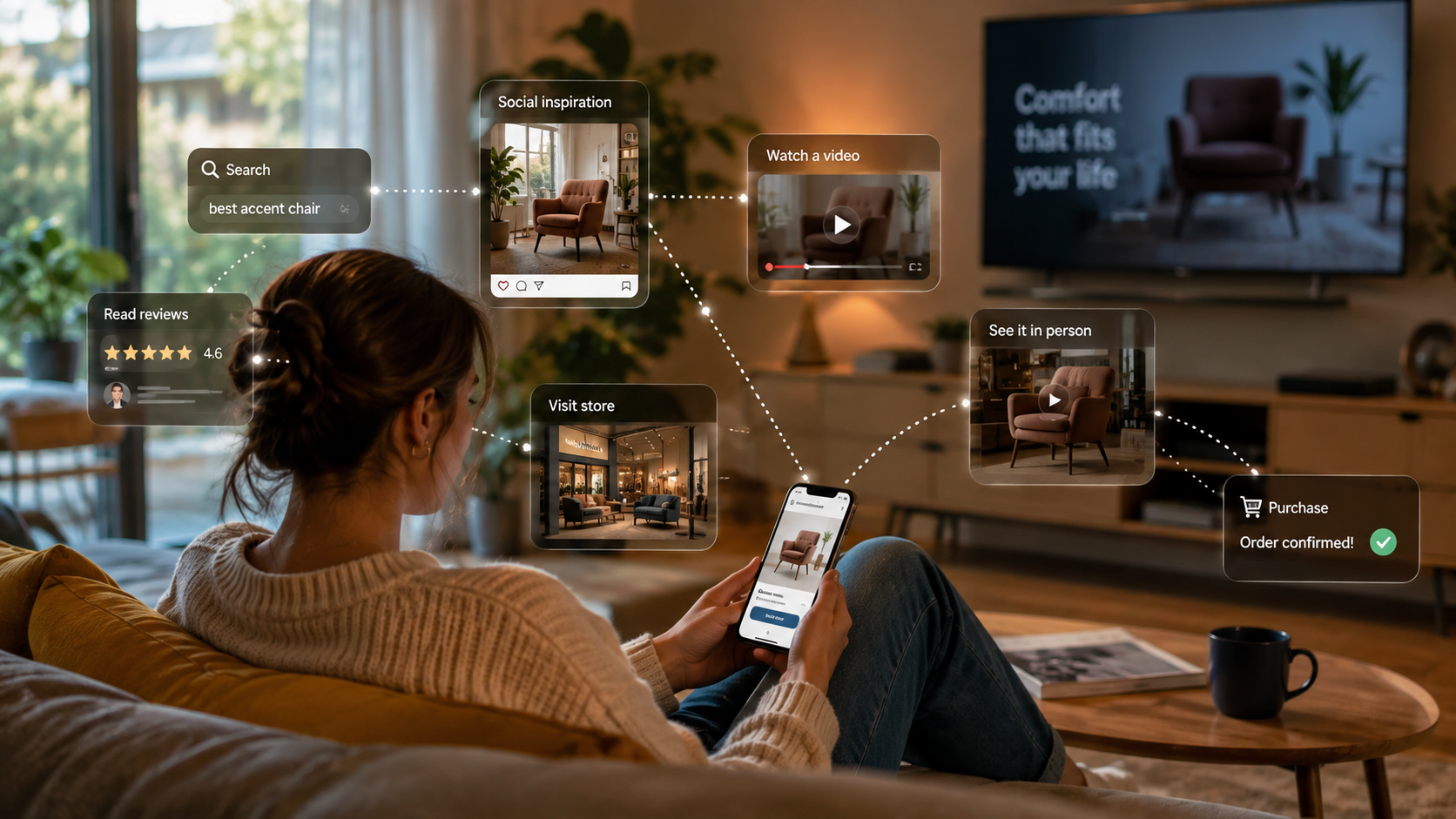
Consumers move forwards and backwards. They discover a product, forget about it, search again, compare alternatives, abandon baskets, ask friends for advice, watch reviews, visit stores, read opinions and sometimes postpone a purchase altogether. A single positive or negative interaction can reshape the entire decision.
The problem is not simply that the journey is nonlinear. It is that marketing can still behave as if communication must perform a predefined role according to where we believe someone sits in a funnel.
Consumers move through decisions, not stages
A consumer does not know that they are in the consideration stage. They know that they have a question, a need, a doubt or a choice to make.
That creates a more useful way to think about the journey: not as a sequence of funnel stages, but as a series of decision moments.
A decision moment occurs whenever something changes the probability of a consumer progressing towards – or away from – a purchase. It may be the moment they identify a need, discover a possible solution, compare alternatives, validate a choice, reduce perceived risk, confirm availability or finally decide to buy. These moments do not necessarily happen in order. Nor do they all require the same type of communication. The funnel is useful as a planning abstraction. It becomes dangerous when we mistake it for consumer behavior.
Not every interaction needs to persuade
One of the consequences of funnel thinking is the assumption that every communication should somehow push the consumer forward. But progress towards a decision is not always created by persuasion. Sometimes the consumer needs inspiration. Sometimes information. Sometimes proof. Sometimes reassurance.
Many purchase decisions are ultimately exercises in reducing uncertainty: Is this right for me? Is there a better alternative? Is the price reasonable? Will it solve my problem? Can I trust the brand? Should I buy now or wait?
At those moments, the role of communication is not necessarily to create more desire. It may simply be to provide enough confidence for a decision to continue.
Retail media brings us closer to decision moments
This is where retail media becomes particularly interesting. Retail environments contain signals that can help us understand not only who a consumer may be, but what they may be trying to do.
Search behavior, category browsing, product comparison, store visits, basket behavior and transactions can all provide context around consumer intent. Instead of relying exclusively on an assumed position in a funnel, communication can become more relevant to the decision taking place.
That changes the question from “Where is this consumer in the funnel?” to “What might this consumer need at this moment?”
The distinction matters. Someone researching a category may need education. Someone comparing two products may need differentiation. Someone standing in front of the shelf may need reassurance. Someone who has already purchased may need help getting more value from the product.
Upper and lower funnel are increasingly connected
This also challenges the traditional separation between brand and performance media.
A consumer standing in front of two products may still need brand reassurance. Someone browsing a retailer’s website may discover a brand for the first time. Someone watching connected TV may already be actively considering a purchase.
The same person can move between behaviors that marketers label upper, mid and lower funnel within a very short period. The channel alone does not tell us where the consumer is in their decision.
That is why the most useful role of modern media may be less about moving people through a predefined journey and more about being relevant across the moments that shape it.
People do not follow marketing frameworks. They follow their own decision-making process.
For brands, the opportunity is therefore not to engineer a perfectly linear path. It is to understand the moments in which consumers need something from communication – discovery, information, comparison, confidence or reassurance – and be useful when those moments occur.
The customer journey was never really a line.
Our ability to understand and respond to it is simply getting better.